
Nexus Market Link — Verified Onion Address & Mirror List
nexusc4fexvg56avvkne2qgmgseaq3inndfwrtdtoz3jwl7hdfqx5dad.onion
PGP-verified primary · secondary mirrors in the registry below
Nexus Market is one of the larger darknet markets still running in 2026. This independent review documents the operational details of the Nexus darknet market, lists every confirmed mirror node, breaks down the anatomy of the 56-character onion address, and walks through the PGP verification workflow used to confirm authorship of every Nexus link before publication.
Phishing clones of the Nexus market are persistent. Visual inspection cannot distinguish a cloned Nexus login page from the genuine market; the only reliable test is a PGP signature check against the operator's public key, which clone operators cannot reproduce. The sections below cover that verification workflow, the Nexus url structure that makes spoofing computationally infeasible, the Nexus market security architecture, and the connection diagnostics most users need when a mirror appears unresponsive.
NexusLink is an independent third-party documentation resource. The site does not operate the Nexus market and holds no affiliation with the Nexus platform. Address records published here are derived from cryptographic verification of the Nexus market's signed canary statements, cross-referenced against independent community archives.
Verified Nexus Market Link Registry
The primary endpoint above is recorded against the most recently signed canary as of May 2026. The two secondary Nexus market mirrors below act as fallbacks when the primary node is under DDoS pressure or in the middle of an address rotation. Every Nexus url has been verified through PGP signature matching against the signed canary; the signature matches the public key archived since the Nexus market launch in 2023.
| Mirror Node | Onion Address | Verification |
|---|---|---|
| Secondary Mirror | nexusck4c5hrdikdhoyh5jxuxzrcm2cfqlk5saqwdkdosu7irbraqgyd.onion |
PGP-verified, canary current |
| Tertiary Mirror | nexuseuszbyooiqnpmstgtzssbcftr43yoj6e3yuo3nrqk7gsipdfead.onion |
PGP-verified, canary current |
"Verification" means three checks have passed at the most recent review: the PGP signature on the canary statement validates against the archived operator key, the canary timestamp falls within the standard recency window (under 14 days at the time of cross-reference), and the address string appears verbatim inside the signed canary body. "Canary current" applies to the May 2026 review cycle; the canary timestamp itself should always be reverified before the address is used.
A Nexus mirror that does not appear in this table is treated as unverified until proven otherwise. Independent community channels occasionally distribute mirror addresses ahead of NexusLink's review cycle, but those should not be trusted on signal alone. Cross-reference any new Nexus url against the published canary text before any login attempt.
What Is Nexus Market — An Editorial Review
Launched in 2023, Nexus Market is a current-generation darknet market that emphasizes cryptographic user protections rather than custodial trust. The project is built around a 2-of-3 multi-signature escrow model, mandatory PGP-based two-factor authentication, and a vendor bonding system that raises the cost of throwaway scam accounts. Operators have maintained continuous Nexus tor market operations through periodic mirror rotations and PGP-signed canary publications since launch.
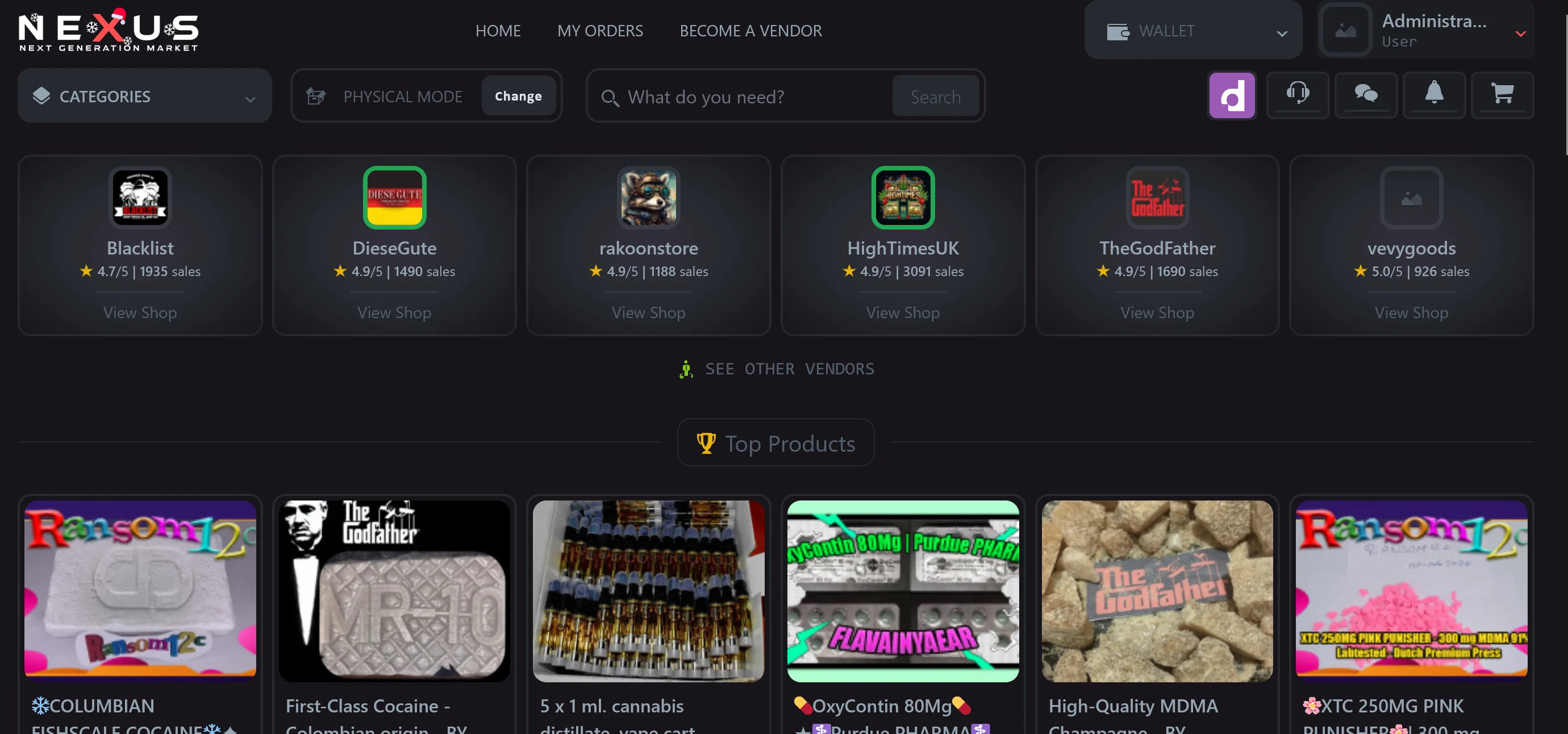
The Nexus website filters vendors at intake. Applications require a PGP-signed message demonstrating that the prospective vendor controls the corresponding private key, a refundable bond deposit, and review by market staff before listings can be published. This barrier is lower than invite-only systems and higher than open-signup markets, producing a vendor base broad enough to cover the categories most users come for and selective enough to filter out the lowest-effort scam attempts.
The Nexus darknet market supports both Bitcoin (BTC) and Monero (XMR) for deposits. XMR has become the default recommendation on Nexus Market; its ring signatures, stealth addresses, and confidential transaction amounts produce protocol-level privacy that Bitcoin requires CoinJoin and careful UTXO management to approach. BTC remains available on the Nexus market because not every user can acquire Monero directly. The full Nexus market payment mechanics, wallet setup, network fees, and deposit confirmation windows are documented separately in the Nexus Market cryptocurrency guide.
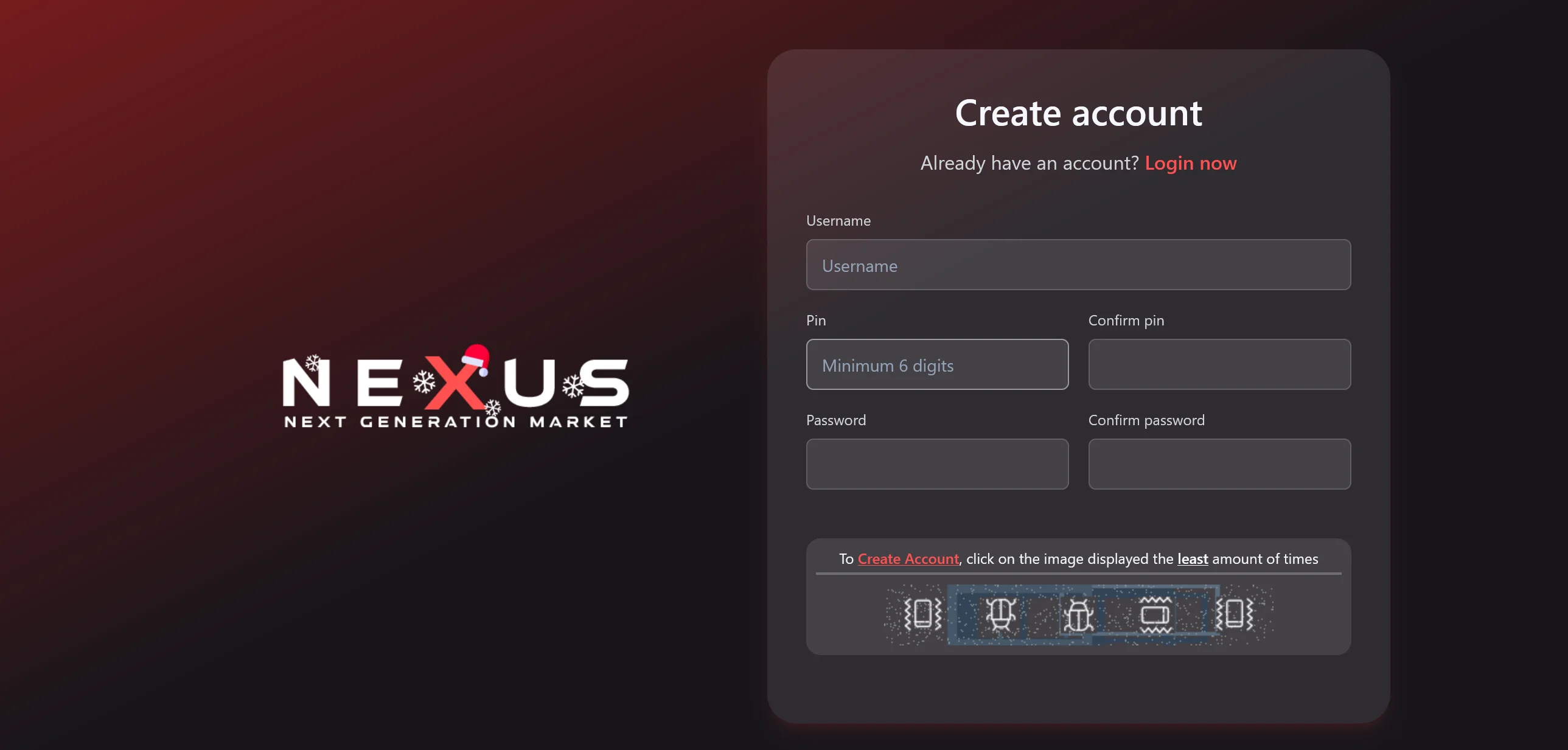
Account creation on Nexus Market does not require email or any clearnet identifier. Users register with a username, a passphrase, and a public PGP key uploaded to the account; the Nexus market issues challenges encrypted to that key for subsequent logins. There is no password recovery. A lost passphrase is a permanently lost Nexus account. This is the standard threat model for current-generation darknet markets and is part of what separates them from clearnet platforms that lean on email-based recovery flows.
Where Nexus diverges from older markets is in the architectural baseline: multi-sig escrow as the default rather than the exception, PGP 2FA as mandatory rather than optional, and proactive mirror rotation rather than waiting for a DDoS event to force the switch. The feature-by-feature breakdown against competing platforms is documented in the Nexus Market comparison report.
Anatomy of a v3 Onion Address
A v3 Nexus onion address is a 56-character base32-encoded string that derives directly from the Nexus market's ed25519 public key. The encoding is deterministic: take the 32-byte ed25519 public key, append a 2-byte checksum derived from a SHA3-256 hash, append a single version byte (the digit 3 for v3), and base32-encode the resulting 35 bytes. The result is exactly 56 characters of lowercase letters and digits, followed by the ".onion" suffix.
This construction means the Nexus onion address is not a name assigned by a registry. It is a cryptographic fingerprint of the Nexus operator's public key. To produce an .onion string that matches the genuine Nexus url, a clone operator would need either the matching ed25519 private key (impossible without compromising the Nexus market's key custody) or the ability to break ed25519 itself (no known practical attack exists). What clone operators do instead is generate vanity addresses with overlapping prefixes and suffixes, hoping users compare only the first and last few characters.
Three properties follow from this structure, and they affect how a Nexus link should be handled:
- Case-insensitive resolution. The v3 onion specification treats addresses case-insensitively. "NEXUSEXAMPLE...onion" and "nexusexample...onion" resolve to the same hidden service. Tor Browser auto-lowercases the address bar regardless of how the string was pasted.
- Built-in integrity check. The 2-byte checksum inside the address means a single-character typo will be rejected by the Tor client before any network lookup. There is no "almost-correct" Nexus onion address; the client fails closed rather than open.
- 56 characters, not 16. The deprecated v2 format used 16-character addresses and 1024-bit RSA keys. Both are weak against modern hash-collision and brute-force attacks. Tor retired v2 hidden service support in October 2021. Any 16-character Nexus address circulating today is either historical or a phishing signal.
The practical consequence: the only spoofing surface that remains is visual deception. A clone with a different .onion string can be served from pixels that look identical to the genuine Nexus market link. This is exactly the gap PGP verification closes.
PGP Verification — Step by Step
Before any Nexus link is published on this site, a PGP signature check confirms that the canary statement listing the address was produced by the holder of the Nexus Market private key. The procedure runs locally with GnuPG and does not require network access beyond fetching the canary file. The full check takes under a minute once the operator key is imported.
Step 1 — Install GnuPG. On Linux, the package is gnupg or gnupg2 in most distributions. On macOS, brew install gnupg covers the install. On Windows, Gpg4win packages the same tooling. Reference documentation is published by the GnuPG Project.
Step 2 — Import the Nexus public key. The Nexus market publishes its public key on its forum and on third-party PGP key directories. Save the ASCII-armored key block as nexus.asc and import it:
gpg --import nexus.ascList the fingerprint after import:
gpg --fingerprint <key-id>The fingerprint is a 40-character hex string grouped in 4-character blocks. Compare it against the fingerprint published in at least two independent community archives. If any digit differs, the key is wrong. Stop and refetch the key from a different source. Reverify the fingerprint before continuing.
Step 3 — Download the signed canary. The canary is a plain-text statement signed with the Nexus operator key. It includes the date, the current onion addresses, and a short statement that the operator has not been compelled to act against users. Save the canary as canary.txt.
Step 4 — Verify the signature.
gpg --verify canary.txtA successful result prints "Good signature from..." followed by the key identifier. A failure prints "BAD signature". A "Good signature" with a warning about "untrusted key" is normal: it means the signature is cryptographically valid but the key has not been manually trusted in the local keyring. The cryptographic validation is the part that matters.
Step 5 — Match the address. Read the canary text. Confirm that the Nexus url you intend to use appears verbatim in the canary body. If the canary lists three addresses and the one in front of you is not among them, the address is not verified regardless of where it was obtained.
Step 6 — Check the canary timestamp. The canary header contains the date of signing. A canary older than 14 days is stale and should not be used to justify a Nexus link. If the canary is recent and the signature validates, the listed addresses are PGP-verified at that point in time.
If the signature fails at any step, the canary file was either modified after signing or signed with a different key. In both cases, the address list inside cannot be trusted. Discard the file, refetch from an independent source, and reverify.
How to Spot a Phishing Clone
Phishing clones of the Nexus website replicate the visual interface byte-for-byte. The login form, the vendor pages, the order flow: all reproducible by anyone with read access to the genuine Nexus market. What clones cannot reproduce is the cryptographic proof that the Nexus operator controls the published address. Identifying a Nexus market clone reduces to a small set of concrete checks.
- Full-string address comparison. Compare every character of the .onion address against the canary text. Clone operators run vanity-address generators that produce strings sharing the first and last 4-6 characters with the genuine address. Reading only the prefix and suffix is the failure mode they design for.
- PGP fingerprint comparison. A clone that hosts its own "canary" will sign it with a key the clone operator controls. The fingerprint of that key will not match the archived Nexus operator fingerprint. A mismatched fingerprint is conclusive evidence of a clone, regardless of how the page looks.
- Origin of the link. Any Nexus link copied from a clearnet search result, a Telegram channel, an unsolicited DM, or a paste-site dump should be treated as untrusted until verified. Phishing campaigns time their pushes to coincide with documented downtime events, exploiting the period when users are most likely searching for an alternative.
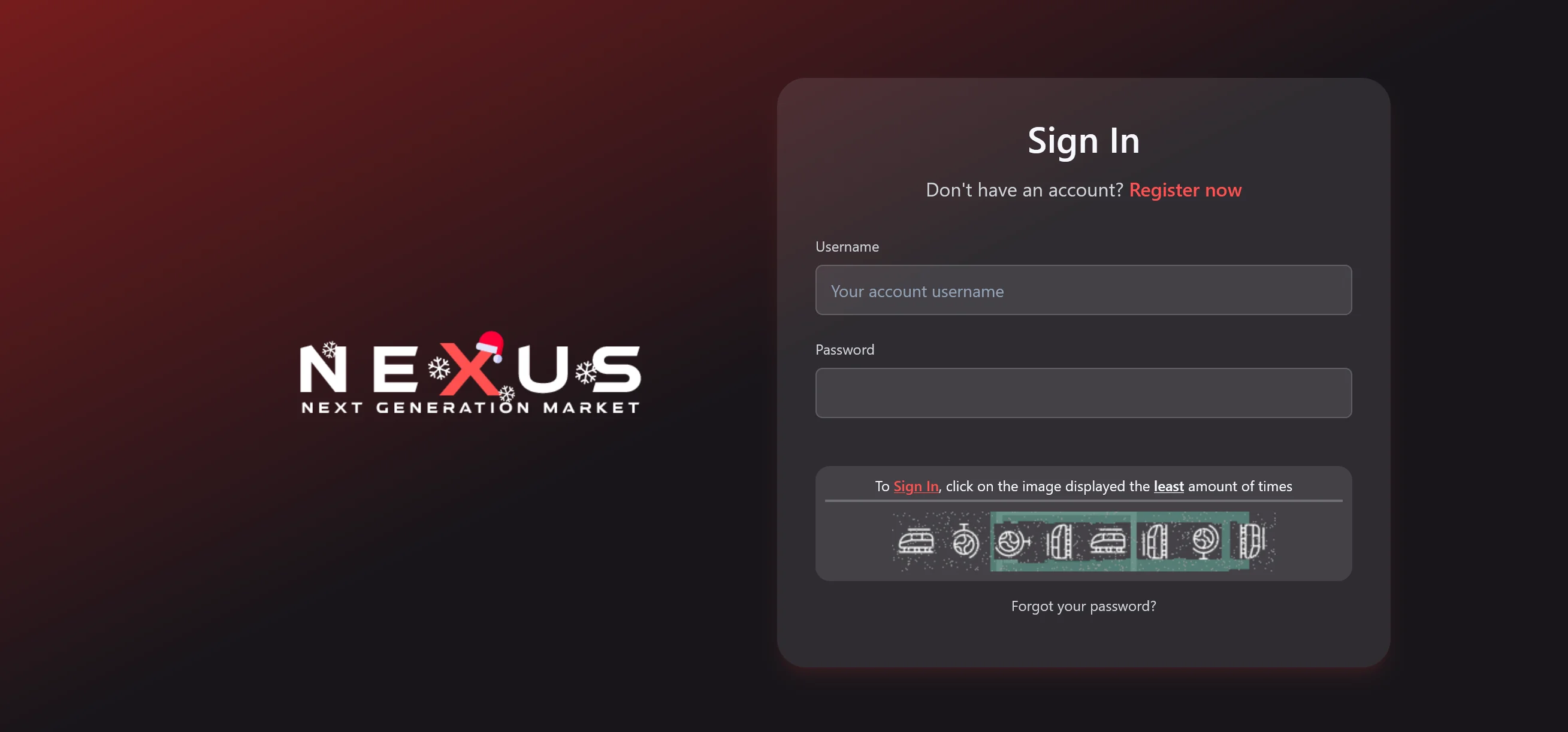
- Login-page anomalies. The genuine Nexus login asks for a username, a passphrase, and a PGP-encrypted challenge response. A clone may add fields the real market does not use: a security question, an email address, a recovery phrase, a "wallet seed" backup option. Every additional field is a red flag.
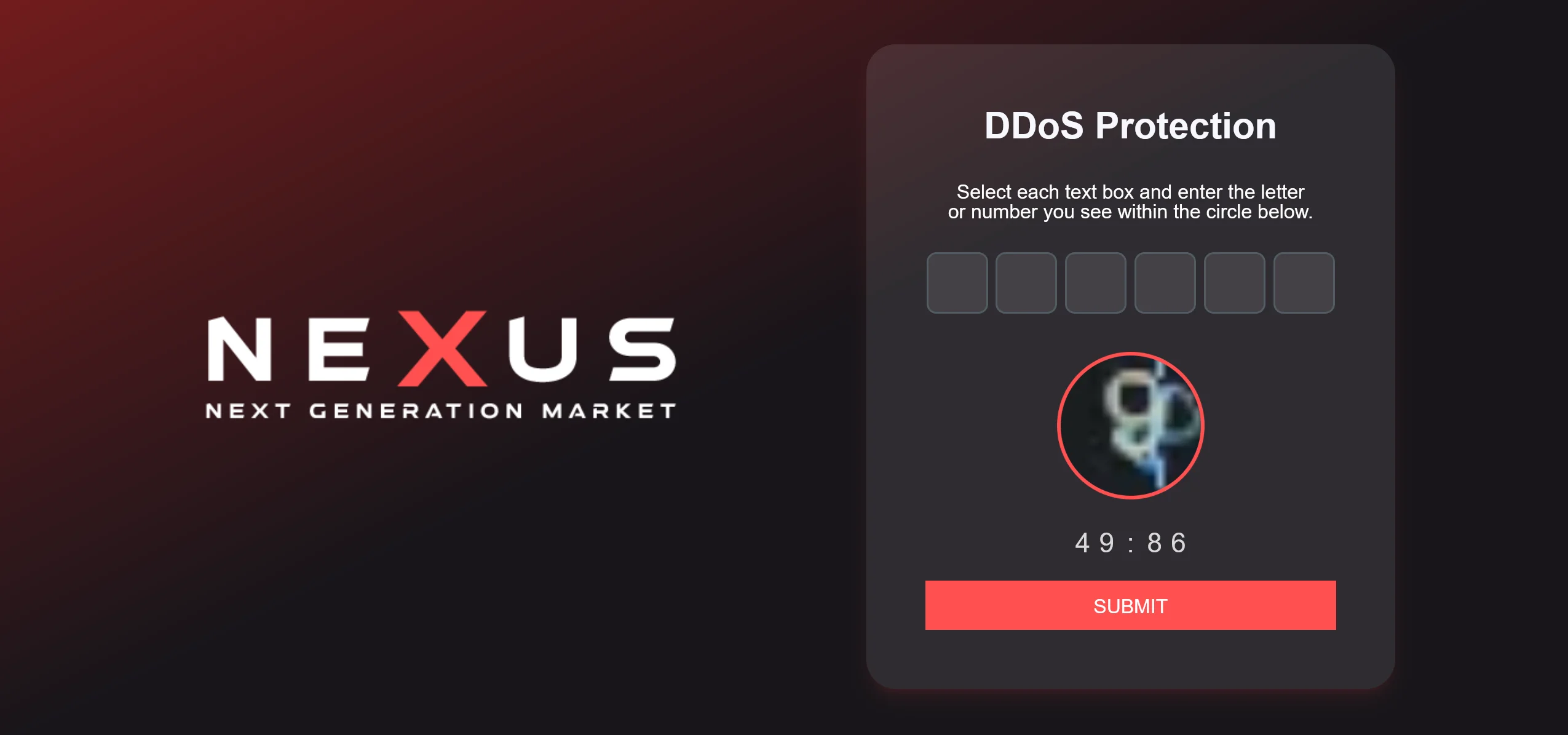
- Captcha behavior. Phishing operators frequently use stock CAPTCHA libraries that behave differently from the market's own captcha. The differences are subtle on their own, but together with other anomalies they reinforce a clone-infrastructure pattern.
The single habit that defeats every phishing variant: do not enter credentials on any Nexus mirror until the canary signature validates against the stored Nexus operator key. Visual recognition is not verification.
Why Onion Mirrors Rotate
Within four to eight weeks of going public, the typical Nexus mirror is retired and a fresh address takes its place. Long-lived hidden service addresses accumulate exposure. Every DDoS botnet operator, every scraper, every adversarial researcher learns the string the longer it stays online; retiring the address resets that exposure.
Three operational triggers account for most Nexus mirror rotations: sustained DDoS pressure against a specific mirror, OPSEC-driven proactive retirement of a long-public address, and infrastructure migrations such as server moves or relay configuration changes. Each rotation is announced through a fresh signed canary, which is the only authoritative source for the current Nexus url set.
The detailed rotation history, uptime patterns, and downtime-vs-exit-scam diagnostics are documented in the Nexus Market uptime & downtime analysis. A bookmarked Nexus link from earlier in the year may still resolve, may resolve to a retired mirror, or may resolve to a different service that has registered the address since: only PGP verification against a current canary disambiguates the cases.
Security Architecture and Threat Model
Assume the Nexus market operator is also a potential adversary. Every protection on Nexus Market either limits what the operator alone can do or gives users cryptographic evidence of operator behavior.
Multi-signature escrow. Nexus market funds are held in 2-of-3 multi-sig wallets across buyer, vendor, and market keys. A normal transaction releases through buyer and vendor signatures. A dispute releases through buyer or vendor plus the market signature. The Nexus market operator alone cannot move funds. This is the structural protection against the Evolution-style exit scam, in which a custodial operator drained the entire escrow wallet in 2015 for roughly $12 million in user funds.
PGP-based two-factor authentication. When 2FA is enabled, and on Nexus it is required for every account, the login flow returns a PGP-encrypted challenge token the user must decrypt locally and submit back. A stolen passphrase alone is insufficient; the attacker would also need the user's PGP private key. This raises the bar substantially compared to TOTP-style 2FA, which is vulnerable to real-time phishing relays that capture and reuse the rolling code in the same session.
Warrant canary. The Nexus market maintains a periodically updated warrant canary. The Nexus canary states that the operator has not been compelled to act against users and has not been served secret orders that prevent disclosure. If the Nexus operator is compromised or coerced, the canary stops updating. A stale canary is not proof of compromise. Operators occasionally miss schedules. But it is the first indicator that warrants closer attention from users who treat the canary as part of their trust model.
Monero integration. XMR is natively integrated to break the blockchain-traceability chain that Bitcoin produces. Transaction amounts, sender, and receiver are cryptographically obscured by default. This is the platform feature most directly relevant to users whose threat model includes financial-flow analysis by chain-analysis firms working with law enforcement.
Vendor bonding and PGP-signed applications. Vendors onboard after submitting a PGP-signed application and depositing a refundable bond. The bond is forfeit if the vendor violates platform policies or is removed for fraud. This is not a guarantee of vendor quality. It does mean a vendor with a long-tenured account has financial and reputational stake in continuing to behave consistently.
No clearnet identifiers in account creation. Account creation requires no clearnet identifiers at all: no email field, no phone field, no SMS recovery, no fallback to an external inbox. The account exists entirely within the Tor session and the user's local keypair. Combined with the absence of any password-recovery flow, this minimizes the data the market holds about its users.
The Tor Network and Onion Address Resolution
How does Tor Browser resolve a 56-character onion address when no DNS lookup is involved? The resolution path is fundamentally different from a clearnet domain query, and that difference is why Tor Browser is required and a standard browser cannot reach a Nexus url.
When Tor Browser connects to a v3 onion address, the client computes the address's hash, queries the Tor distributed hash table (the HSDir ring) for descriptors signed by the corresponding key, and learns which introduction points the hidden service is currently using. The client then negotiates a rendezvous point (a third-party relay both sides can reach without revealing their location), and the connection completes through a six-hop circuit (three hops on each side). This is why hidden services run slower than clearnet sites; the path length is double.
The 56-character v3 format uses ed25519 keys with SHA3-256 hashing. The deprecated v2 format used 1024-bit RSA with SHA-1. Both v2 algorithms have known weaknesses, and the 16-character address length created a real risk of vanity-prefix collisions in which a determined attacker could generate an address visually similar to a target. The Tor Project retired v2 hidden service support entirely in October 2021. If a source distributes a 16-character Nexus onion address today, the source is either out of date or running a phishing operation against users who have not noticed the format change.
Tor Browser ships with three security levels. The "Standard" level allows JavaScript everywhere. "Safer" disables JavaScript on non-HTTPS sites and removes several media features. "Safest" disables JavaScript globally and blocks several rendering features that have produced deanonymization exploits in past Tor Browser releases. For reaching any Nexus tor market mirror, "Safer" is the practical baseline; users with elevated threat models run "Safest" and accept the trade-off of broken JavaScript-dependent functionality. The Tor Browser package is published by the Tor Project.
Networks that block Tor outright require bridges, which are unlisted relays the censoring network has not yet enumerated. Bridges are obtained from the Tor Project's bridge distribution service. Once a bridge is configured, the rest of the circuit-building process is identical, and the Nexus onion address resolves the same way it would on an unfiltered network.
Position in the 2026 Darknet Market Ecosystem
Several major darknet markets are operating in 2026. Among them, Nexus occupies the mid-to-upper tier on the architectural-baseline axis: multi-sig escrow, mandatory PGP 2FA, multi-mirror redundancy, and a regular canary cadence. Markets that score higher tend to differentiate on vendor selectivity through invite-only systems or on dispute response time; markets that score lower typically use custodial escrow, slower mirror rotation, or weaker 2FA defaults.
What Nexus does not have is the sheer scale of certain competitors in continuous operation since before 2020. Smaller markets accumulate fewer vendors, narrower product categories, and shorter operational history. All three are legitimate factors for a user assessing where to place trust. Nexus has been running since 2023, which is long enough to demonstrate operational discipline but short enough that long-tail edge cases (extended DDoS campaigns, key compromise events, regulatory action) have not been fully tested in public.
The detailed comparison of escrow models, mirror counts, vendor onboarding, dispute resolution, and cryptocurrency support across the current Nexus tor market generation is documented in the Nexus Market comparison report. Users with a specific threat model (financial-flow analysis, account-recovery concerns, vendor reliability, or DDoS tolerance) will find the trade-offs broken out there in more detail than is useful to repeat on this page.
Troubleshooting Connection Issues
If a verified Nexus url or mirror node fails to load, the most common causes are local Tor circuit issues or a single-mirror outage rather than a full Nexus market disruption. Run through the diagnostics below in order before concluding the Nexus market is down.
- Check Tor Browser connectivity. Open a known-good onion site (the DuckDuckGo hidden service is a useful test because its uptime is independent of the Nexus tor market). If nothing loads, request a new Tor circuit from the Tor Browser menu, or restart the browser entirely.
- Try alternative mirrors. If the primary Nexus link is slow or unresponsive due to network congestion, test the secondary and tertiary mirrors listed in the registry table above. DDoS attacks typically target one mirror at a time; rotating to another verified address resolves most short-duration outages.
- Interpret the error message. "Onionsite has disconnected" usually means the mirror is responding but timing out, which fits a DDoS or congestion pattern. "Onionsite Not Found" means the descriptor lookup failed entirely, which can indicate the address has rotated or the hidden service is offline. Error codes prefixed with 0xF (introduction-point handshake failures) usually clear after a fresh Tor circuit is built.
- Confirm operational status. Consult the Nexus Market status page for the current operational record. If the issue is a sitewide event, it will be documented there rather than affecting only your connection.
- Wait and reverify. When every documented mirror is unresponsive simultaneously, the worst response is to start searching clearnet for "new Nexus links". Phishing operators time their pushes to coincide with downtime events because users are most exposed in those windows. Wait for a fresh signed canary; do not chase unverified replacements.
Connection problems that persist across all three Nexus tor market mirrors for more than 24 hours are unusual based on documented operational patterns. When this combination occurs, the diagnostic priority shifts from "which Nexus mirror to try next" to "has the Nexus operator published a status update or a fresh canary," and both questions are answered through the verification workflow described earlier on this page.
Frequently Asked Questions: Nexus Market Link
How often does the Nexus onion address change?
Mirror rotations on the Nexus darknet market occur roughly every four to eight weeks based on documented patterns since 2023. The primary endpoint has historically rotated less frequently than the secondary and tertiary mirrors. Each rotation is announced through a fresh signed canary; an address that disappears without a canary update is treated as unverified rather than rotated.
Is the Nexus Market link case-sensitive?
No. The v3 onion specification treats addresses case-insensitively, and Tor Browser auto-lowercases the address bar regardless of how the string was pasted. "NEXUSEXAMPLE.onion" and "nexusexample.onion" resolve to the same hidden service. The lowercase form is the canonical representation used throughout this site.
What happens if PGP verification of a Nexus link fails?
A failed signature means the canary file was either modified after signing, signed with a different key, or both. In either case, the address list inside the canary cannot be trusted. Discard the file, refetch from an independent community archive, reverify the operator key fingerprint against multiple sources, and run the signature check again. Do not use the addresses until the signature validates cleanly.
Can a Nexus link be saved in a bookmark?
The Nexus url can be bookmarked, but the bookmark loses authority the moment the address rotates. A bookmark from three months ago may point to a retired mirror, an unrelated service that has registered the address since, or a phishing clone deliberately set up against the abandoned string. Reverify the bookmark against the current signed canary before each session.
Why doesn't this page link to the Nexus onion directly?
Onion addresses on this site are rendered as plain text rather than clickable hyperlinks. The purpose of NexusLink is to document and verify the Nexus market link, not to function as a one-click gateway. A user who has read the verification methodology is in a better position to evaluate the address than one who has clicked it sight unseen.
How NexusLink Verifies the Nexus Market Link List
NexusLink is an independent analysis and documentation site. Every Nexus link published here passes through the same review process, applied identically across primary endpoints and mirror nodes.
- Cryptographic attestation. Each new canary statement is verified against the established Nexus operator public key. A signature that does not validate against the archived fingerprint is rejected: the canary is not published, and no address derived from it appears on this site.
- Multi-source corroboration. An address listed in a verified canary is cross-referenced against at least one independent community archive before publication. This is the defense against a key-compromise scenario in which a hostile party signs a canary with a key the legitimate operator no longer controls.
- Operational pattern monitoring. Mirror availability is checked periodically against the documented uptime baseline. Outages that exceed the documented norm are recorded. Real-time uptime tracking is published separately on the Nexus uptime record.
- Methodology disclosure. The full editorial methodology, including primary verification, community intelligence sourcing, and historical documentation, is published on the About page. The verification record stands or falls on the reproducibility of these checks.
What this methodology does not do: monitor in real time, guarantee future operator behavior, or provide assurance that a verified Nexus url will remain valid past the next canary cycle. The verification is a point-in-time record, not a continuous warranty. The reader is the last line of defense; the workflow on this page is the toolkit.